1032
10 min
SAP S/4HANA Migration: Brownfield, Greenfield, and Selective Data Transition (SDT/Bluefield)

Ksenia Razumovskaya
Business Development Manager, TeamIdea Group
Choosing the Right Path to SAP S/4HANA Cloud

Migrating to SAP S/4HANA Cloud is more than a technical upgrade; it is a strategic transformation of an enterprise’s IT architecture. Organizations face a critical choice: retain s current system as is and simply modernize the underlying platform or start from scratch and reimplement the system fully. And of course, there is an option in between. There are three main migration approaches: System Conversion (Brownfield), New Implementation (Greenfield), and Selective Data Transition approach also known as Bluefield. But what approach to be chosen? TeamIdea experts help companies make well-grounded decisions and achieve a smooth transition to SAP S/4HANA. In this article, we review three migration approaches and highlight the key advantages and limitations of each. Understanding the differences, benefits, and appropriate use cases for each approach is key to a successful transformation.
Brownfield: System Conversion
System Conversion, also known as Brownfield, is a technical migration from SAP ECC to SAP S/4HANA while preserving existing business processes, configurations, and customizations.We advise to choose the Brownfield strategy when:
- There is no immediate need for organizational changes or business transformation, IT is the main driver for change
- Minimal process redesign is required.
- Historical data and customizations need to be retained.
- Business is not ready to go for a complex project and needs a phased implementation approach.
Key Characteristics of this method:
- Quick migration with technical focus.
- All historical data and configurations are carried over.
- Limited change of business processes.
- Lower risk for organizations with stable, proven and relatively time and cost - affective processes.
So, Brownfield is suitable for organizations seeking a fast, low-risk transition while maintaining continuity of operations. It prioritizes speed and allows to do gradual transformation in waves once conversion is complete.
Greenfield: New Implementation
New Implementation, or Greenfield, is a clean start, implementing SAP S/4HANA as a new system while redesigning business processes and adopting SAP best practices.When to choose Greenfield:
- High demand from the business for transformation
- Operating model changes or organizational changes are expected.
- Company is ready to undergo a large-scale implementation project
- Historical data is less critical, or only selected reference data needs migration.
Key characteristics of this approach:
- Complete or partial redesign of processes
- Opportunity to remove legacy customizations and follow clean core proinciples.
- Strong focus on standardization, innovation, and adoption of SAP best practices.
- Longer project timelines due to process reengineering and system redesign.
Selective Data Transition (SDT/Bluefield): The Hybrid Approach
Selective Data Transition, also called Bluefield, bridges the gap between Brownfield and Greenfield. It allows organizations to selectively reuse existing processes and data while redesigning others, combining the best of both approaches.What SDT offers:
- Selective data migration: transfer only relevant historical data instead of the full legacy dataset.
- Process optimization: retain only critical processes and custom applications, while redesigning the rest
- System flexibility: merge, split, or reorganize entities and systems according to business needs.
- Flexible go-live options: staged migration by organizational units, big-bang implementation, or near-zero downtime options.
- Minimal disruption: business operations continue smoothly, even for partially delivered transactions.
When SDT is justified:
- Companies aiming to balance speed, risk, and modernization.
There is a business case for change which requires Greenfield but historical data must be also retained
Enterprises with complex landscapes, multiple entities, and heavily customized ERP systems.
Comparing the Approaches
Please, see this simple chart to compare strengths and weaknesses of each method: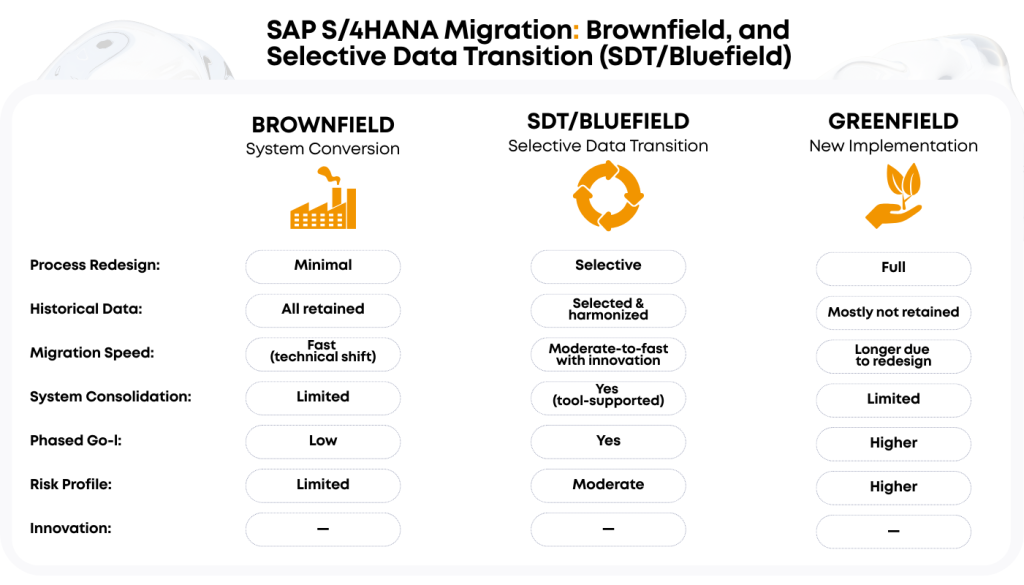
Expert Collaboration: Ensuring Success
SAP has established the Selective Data Transition Engagement, a coalition of SAP and partner experts including TeamIdea and several other companies. Their mission is to:- Ensure high-quality project management and technical execution.
- Define best-practice transition scenarios for phased go-lives.
- Align migration content while allowing partners to apply proprietary tools.
This collaboration reduces project risk, accelerates time to value, and optimizes total cost of ownership for SDT-based transitions.
How to Approach Migration
1. Define the Transition Scenario:- Brownfield for continuity and speed.
- Greenfield for complete process redesign and modernization.
- SDT/Bluefield for selective reuse and targeted innovation.
2. Choose the Cloud Model:
- Cloud Public Edition: Fully SaaS, suitable for smaller businesses and standardized operations.
- Cloud Private Edition (RISE with SAP): Offers flexibility, staged migration, and process adaptation.
3. Follow the Clean Core Principle:
Minimize modifications and extensions to reduce costs, simplify upgrades, and support future innovations.
4. Prepare Data and Assess Readiness:
Use SAP Readiness Check, Custom Code Migration App, Maintenance Planner, and Business Transformation Center. Temporary Compatibility Packs are available for legacy modules.
5. Leverage RISE with SAP Methodology:
Define target architecture, manage change, ensure project visibility, implement DevOps and update automation.
6. Plan Integration and Development:
Integrate SAP S/4HANA Cloud with CRM, SCM, HCM, SAP BTP, and external systems. Pay special attention to migrating SAP BW to Datasphere and HCM to S/4HANA or SuccessFactors.
7. Continuously Evolve:
After migration, stabilize operations and leverage embedded analytics, AI services, automation, and cloud innovations.
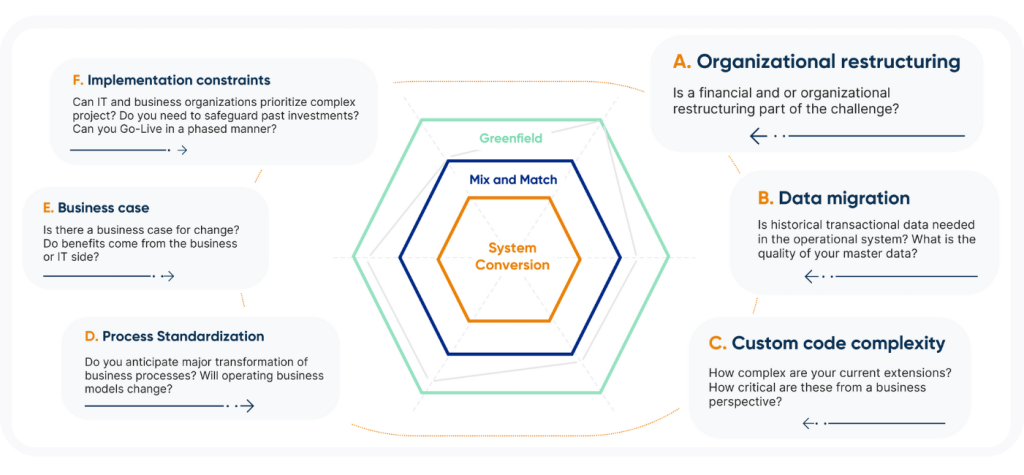
TeamIdea has a proven methodology to guide our customers in their choice of implementation strategy.
Conclusion

Choosing the right path—Brownfield, Greenfield, or SDT/Bluefield—depends on your organization’s process maturity, complexity, and innovation goals. While Brownfield ensures continuity and speed, Greenfield delivers full modernization, and SDT provides a balanced approach, allowing selective reuse of data and processes while enabling transformation. And TeamIdea’s experts are fully ready to give you a hand with the right strategy.