349
14 min
How SAP’s Cloud Changes the Project During Transition

Ksenia Razumovskaya
Business Development Manager, TeamIdea Group
Transition from traditional SAP ERP system to SAP S/4HANA is no longer merely a technical upgrade. It represents a strategic shift toward a cloud-based operating model and fundamentally different implementation approaches.
And in this strategic transition, your colleagues and friends from TeamIdea are ready to help you to make it as comfortable and cost-effective as possible.
SAP’s cloud-first direction is obvious. Innovation in the SAP platform is now primarily delivered through cloud editions, both public and cloud. Often under the RISE model.
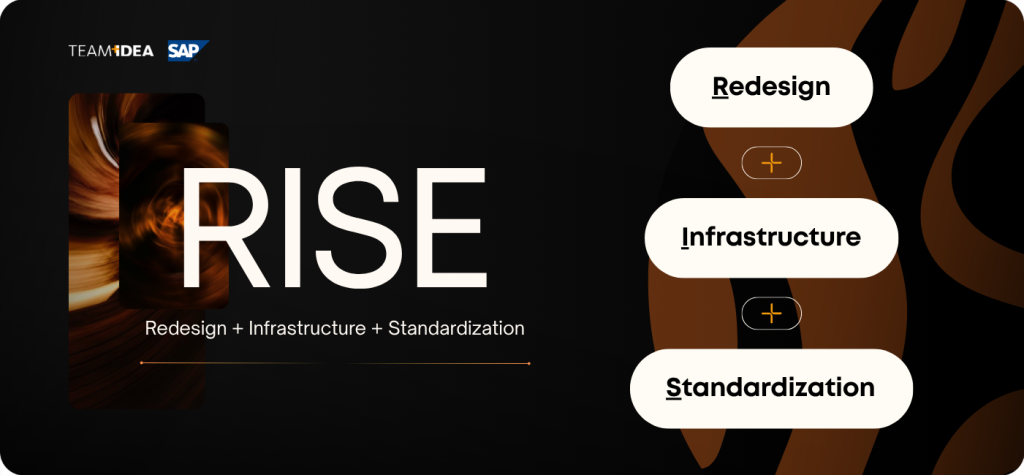
To put it simple, what RISE abbreviation stands for:
Redesign — you analyze current processes and remove unnecessary ones.
Infrastructure — you migrate data from your own servers to hyperscalers (AWS, Azure, Google).
Standardization— you migrate to a unified SAP standard to easily receive updates and AI features.
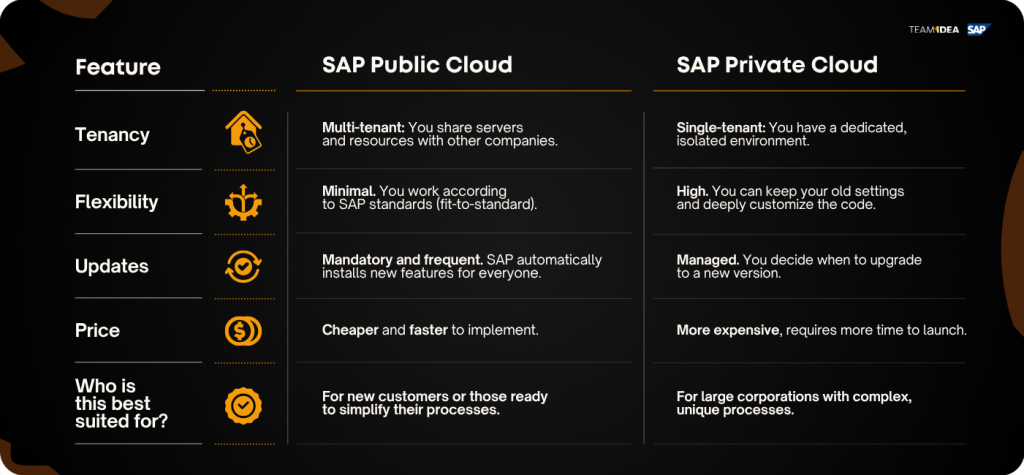
And the main differences between Public and Private Cloud in the SAP ecosystem are the level of control, flexibility, and system update method. Please, see the table below:
Cloud projects are different. They are driven much more by business goals. In Public Cloud environments, processes are standardized. Instead of rebuilding every historical customization, companies are expected to align their processes with built-in industry best practices.
This changes how projects are run. There are more process workshops and fewer discussions about technical fixes. Business owners get involved earlier, executive sponsorship is needed from the start, and cross-functional alignment becomes essential. In cloud conversion, leadership from the business side plays a central role, not just IT.
Scope discipline also becomes stricter. Public Cloud limits deep system modifications, and even Private Cloud models encourage simplification. Companies must clearly define what is in scope, remove unnecessary custom code, and streamline processes. Technical complexity may decrease, but the need for structured change management grows. The focus shifts from replicating legacy logic to redesigning operations for future growth.
Financial planning changes as well. On-premise programs usually require hardware investments and capital-intensive budgets. Cloud conversion replaces this with subscription models and operating expenses. Costs become recurring and more predictable, while infrastructure spending declines. CFOs become more involved, as business cases must reflect subscription fees, infrastructure savings, IT efficiency gains, and the value created through innovation. The financial logic of the program evolves together with the delivery model.
The Horizontal axis is innovation impact: i.e., access to all and continuous updates, AI functions, automation capabilities, embedded analytics and integration into ecosystem. And the Vertical axis is organizational agility, i.e. ability to scale, adapt processes, integrate quickly, respond to market shifts and adopt new capabilities rapidly.
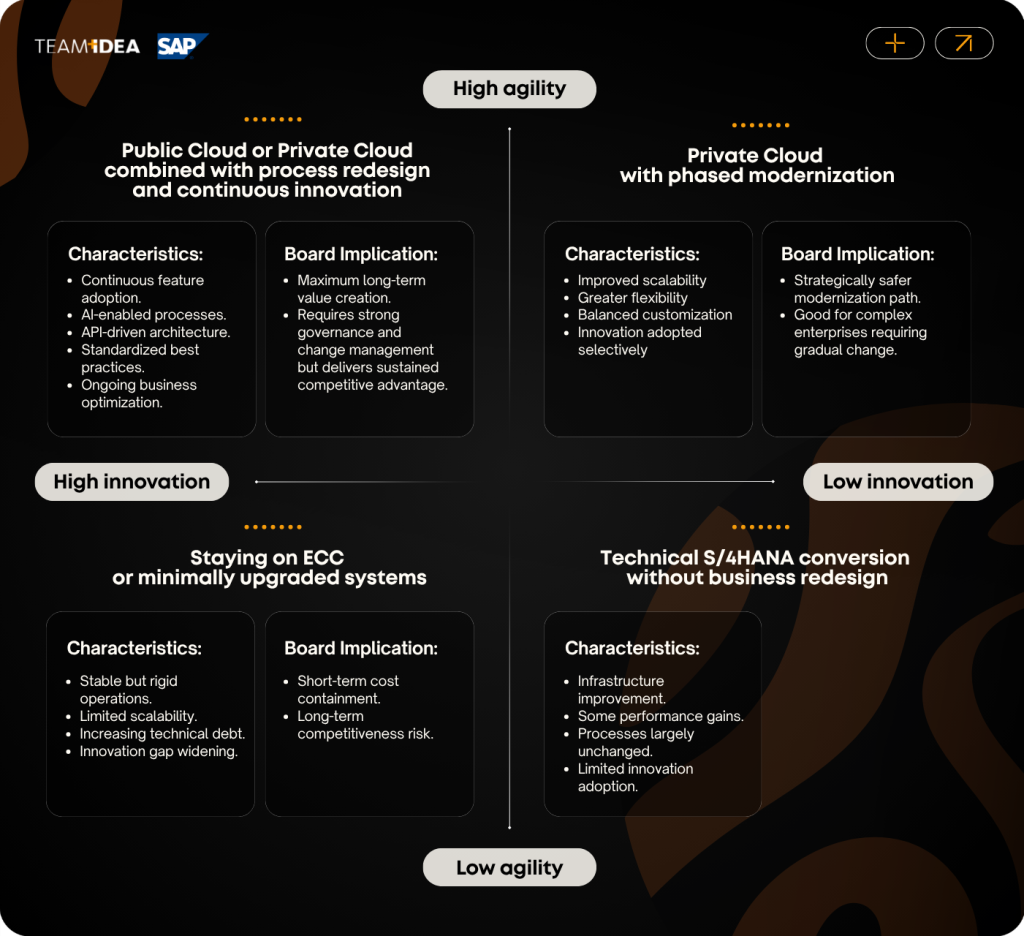
This quadrant matrix also shows a clear pattern: Agility and innovation scale significantly with cloud adoption. Maximum value is realized when cloud migration is combined with business transformation, not limited to technical conversion. And here is an executive interpretation of the above quadrant.
The matrix shows a critical insight: moving to S/4HANA alone does not guarantee strategic value. Value is unlocked only when cloud deployment is combined with organizational transformation. And therefore, the real strategic decision is not: Should we migrate? But rather: Which part of the quadrant do we want to operate in for the next decade?
A move to the cloud affects much more than infrastructure. It changes governance, delivery methodology, customization strategy, budgeting logic, risk management, and even how internal roles are defined.
Now let’s take a closer look at some practical issues, and we start with how transition evolves from technical upgrade to business-led transformation. Because cloud projects work differently — especially in Public Cloud.
As the matter of fact, traditional on-premise conversions are usually treated as technical programs. The focus is on data migration, adapting custom code, ensuring compatibility, and achieving system stability after go-live.
Public cloud environments enforce standardized processes. Instead of rebuilding every historical customization, companies are expected to align their processes with industry best practices embedded in the cloud SAPA S/4HANA solution. In simple terms: you adapt the business to the system, not the system to the business.
And this, of course, changes the dynamics of the project, namely:
The center of gravity shifts from IT to business leadership. And that is why the cloud transformation is not just a system upgrade. It is an operating model discussion.
This forces organizations to:
In many cases, technical complexity decreases because there is less custom logic. But at the same time, organizational change management effort increases. The project becomes less about recreating legacy functionality and more about redesigning how the company operates going forward. And that shift is often underestimated.
On-premise projects typically involve:
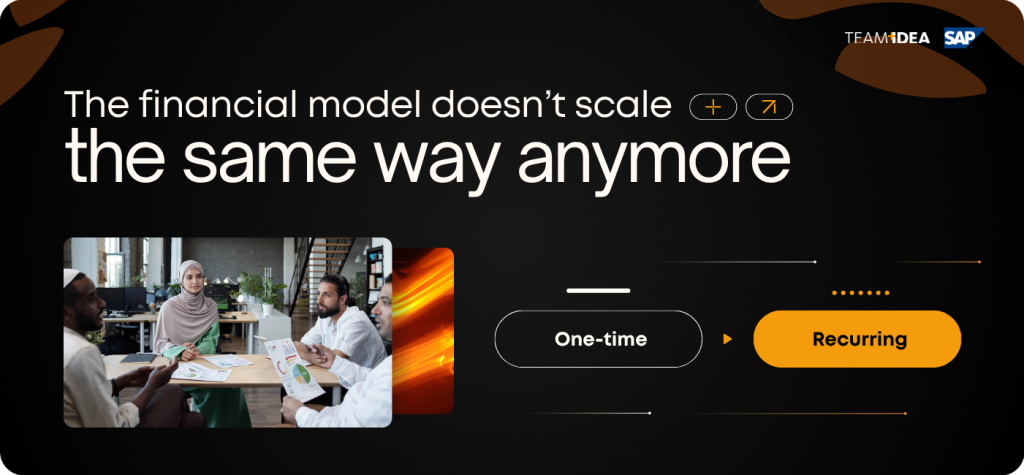
Cloud conversion changes the financial model entirely. Instead of capital-heavy spending, companies move to:
This significantly increases CFO involvement. Financial planning must now include:
The business case is no longer just about technical modernization. It becomes a financial transformation exercise.
Given that, your organization should establish:
To put it simply, cloud ERP is dynamic. It evolves constantly. Companies must evolve with it.
In on-premise systems, infrastructure security, backups, and disaster recovery are primarily managed by internal IT teams.
In cloud environments:
However, customers still remain responsible for:
Clear definition of shared responsibility boundaries is critical. Misunderstanding this is a common risk in cloud programs.
Provisioning becomes faster. It is easier to spin up sandbox systems, create test environments, and scale capacity during peak loads. As a result, project timelines become less dependent on infrastructure readiness and more dependent on organizational readiness.
The bottleneck shifts from technology to people and processes.
Cloud-first architecture promotes:
Legacy point-to-point integrations are often replaced by standardized integration services. This requires rethinking integration governance, data ownership, and extension strategy during the project — not after go-live. Ignoring integration redesign is one of the most common mistakes in cloud transitions.
Cloud projects require:
In many programs, organizational change management consumes more effort than the technical migration itself. Technology is rarely the hardest part. Behavioral change is.
Cloud reduces certain risks:
But at the same time, it introduces new risks:
Cloud projects rarely fail because of technology limitations. They fail because organizations treat them as technical upgrades instead of transformation programs.
It reshapes: implementation methodology, financial planning, governance structures, customization philosophy, post-go-live operating model.
Organizations that approach cloud conversion as a technical migration limit their results. Those that treat it as a structured, business-led transformation and unlock:
The cloud is not just where the system runs. It defines how the enterprise evolves.
For those seeking additional information or assistance in transitioning to cloud solutions,

TeamIdea specialists are available to provide consulting assistance and help resolve complex issues requiring greater expertise and experience.
And in this strategic transition, your colleagues and friends from TeamIdea are ready to help you to make it as comfortable and cost-effective as possible.
How your projects get transformed: a step-by-step analysis and guide
As SAP increasingly prioritizes cloud innovation, organizations planning a system conversion must recognize that moving to the cloud does not simply change where the system is hosted — it transforms the entire project dynamic.SAP’s cloud-first direction is obvious. Innovation in the SAP platform is now primarily delivered through cloud editions, both public and cloud. Often under the RISE model.
To put it simple, what RISE abbreviation stands for:
Redesign — you analyze current processes and remove unnecessary ones.
Infrastructure — you migrate data from your own servers to hyperscalers (AWS, Azure, Google).
Standardization— you migrate to a unified SAP standard to easily receive updates and AI features.
And the main differences between Public and Private Cloud in the SAP ecosystem are the level of control, flexibility, and system update method. Please, see the table below:
New features of SAP S/4HANA Cloud: why they matter for the project
While on-premise systems remain supported, new capabilities increasingly appear first — and sometimes exclusively — in cloud environments. This evolution directly affects long-term competitiveness. Companies that remain on-premise may retain stability, but they risk falling behind in automation, AI-driven analytics, integration capabilities, and continuous innovation cycles. However, the real impact of cloud adoption is felt within the project itself. A cloud transition reshapes governance, methodology, budgeting, risk distribution, internal roles, and delivery models. It alters how decisions are made, how scope is controlled, and how value is realized.Some background info to understand the essence of the transition
Traditionally, on-premise conversions were mostly technical projects. The focus was on migrating data, adapting custom code, and making sure everything worked after go-live. Success meant system stability.Cloud projects are different. They are driven much more by business goals. In Public Cloud environments, processes are standardized. Instead of rebuilding every historical customization, companies are expected to align their processes with built-in industry best practices.
This changes how projects are run. There are more process workshops and fewer discussions about technical fixes. Business owners get involved earlier, executive sponsorship is needed from the start, and cross-functional alignment becomes essential. In cloud conversion, leadership from the business side plays a central role, not just IT.
Scope discipline also becomes stricter. Public Cloud limits deep system modifications, and even Private Cloud models encourage simplification. Companies must clearly define what is in scope, remove unnecessary custom code, and streamline processes. Technical complexity may decrease, but the need for structured change management grows. The focus shifts from replicating legacy logic to redesigning operations for future growth.
Financial planning changes as well. On-premise programs usually require hardware investments and capital-intensive budgets. Cloud conversion replaces this with subscription models and operating expenses. Costs become recurring and more predictable, while infrastructure spending declines. CFOs become more involved, as business cases must reflect subscription fees, infrastructure savings, IT efficiency gains, and the value created through innovation. The financial logic of the program evolves together with the delivery model.
Agility and Innovation, and how they are interconnected in projects
Here is a simple quadrant, a matrix, which compares agility vs innovation impact. Where:The Horizontal axis is innovation impact: i.e., access to all and continuous updates, AI functions, automation capabilities, embedded analytics and integration into ecosystem. And the Vertical axis is organizational agility, i.e. ability to scale, adapt processes, integrate quickly, respond to market shifts and adopt new capabilities rapidly.
This quadrant matrix also shows a clear pattern: Agility and innovation scale significantly with cloud adoption. Maximum value is realized when cloud migration is combined with business transformation, not limited to technical conversion. And here is an executive interpretation of the above quadrant.
The matrix shows a critical insight: moving to S/4HANA alone does not guarantee strategic value. Value is unlocked only when cloud deployment is combined with organizational transformation. And therefore, the real strategic decision is not: Should we migrate? But rather: Which part of the quadrant do we want to operate in for the next decade?
A move to the cloud affects much more than infrastructure. It changes governance, delivery methodology, customization strategy, budgeting logic, risk management, and even how internal roles are defined.
Practical breakdown of what really changes in a cloud transition
Now let’s take a closer look at some practical issues, and we start with how transition evolves from technical upgrade to business-led transformation. Because cloud projects work differently — especially in Public Cloud.
As the matter of fact, traditional on-premise conversions are usually treated as technical programs. The focus is on data migration, adapting custom code, ensuring compatibility, and achieving system stability after go-live.
Public cloud environments enforce standardized processes. Instead of rebuilding every historical customization, companies are expected to align their processes with industry best practices embedded in the cloud SAPA S/4HANA solution. In simple terms: you adapt the business to the system, not the system to the business.
And this, of course, changes the dynamics of the project, namely:
- More process design workshops
- Fewer discussions about deep technical modifications
- Strong business involvement from the early phases
- Executive sponsorship required much sooner
- Cross-functional alignment becomes essential
The center of gravity shifts from IT to business leadership. And that is why the cloud transformation is not just a system upgrade. It is an operating model discussion.
When scope discipline becomes critical
Cloud environments limit deep system modifications. In Public Cloud, core changes are heavily restricted. Even in Private Cloud models, simplification is strongly encouraged.This forces organizations to:
- Define scope very clearly
- Eliminate unnecessary custom code
- Simplify processes
- Increase transparency
In many cases, technical complexity decreases because there is less custom logic. But at the same time, organizational change management effort increases. The project becomes less about recreating legacy functionality and more about redesigning how the company operates going forward. And that shift is often underestimated.
From a financial standpoint, budgeting shifts from to OPEX
On-premise projects typically involve:
- Hardware investments
- Infrastructure setup
- Large capital expenditures
- Long upgrade cycles
Cloud conversion changes the financial model entirely. Instead of capital-heavy spending, companies move to:
- Subscription-based licensing
- Operational expenditure (OPEX)
- Predictable recurring costs
- Bundled service models (such as RISE-type offerings)
This significantly increases CFO involvement. Financial planning must now include:
- Long-term subscription modeling
- Infrastructure cost savings
- Internal IT optimization
- Value creation through innovation and agility
The business case is no longer just about technical modernization. It becomes a financial transformation exercise.
Continuous innovation instead of periodical upgrades
In traditional on-premise landscapes, major upgrades happen every few years. They require heavy regression testing and are often treated as standalone projects. In the cloud, updates are continuous. Release cycles may be quarterly or biannual. Feature adoption becomes ongoing. Innovation is no longer project-based — it becomes operational. This means the project does not truly “end” at go-live. It transitions into a continuous enablement model.Given that, your organization should establish:
- Release governance structures
- Change impact assessment processes
- Business readiness and communication routines
To put it simply, cloud ERP is dynamic. It evolves constantly. Companies must evolve with it.
Security and shared responsibility
In on-premise systems, infrastructure security, backups, and disaster recovery are primarily managed by internal IT teams.
In cloud environments:
- Infrastructure security is managed by the vendor and hyperscalers
- Compliance certifications are centralized
- Backup and disaster recovery are standardized
However, customers still remain responsible for:
- Role and authorization design
- Access governance
- Data privacy compliance
Clear definition of shared responsibility boundaries is critical. Misunderstanding this is a common risk in cloud programs.
Infrastructure is no longer the bottleneck
Cloud removes traditional infrastructure constraints such as:- Hardware procurement delays
- Capacity planning limitations
- Data center maintenance
Provisioning becomes faster. It is easier to spin up sandbox systems, create test environments, and scale capacity during peak loads. As a result, project timelines become less dependent on infrastructure readiness and more dependent on organizational readiness.
The bottleneck shifts from technology to people and processes.
Integration architecture evolves
Cloud-first architecture promotes:
- API-based integrations
- Event-driven connectivity
- Platform extensions via modern integration layers
Legacy point-to-point integrations are often replaced by standardized integration services. This requires rethinking integration governance, data ownership, and extension strategy during the project — not after go-live. Ignoring integration redesign is one of the most common mistakes in cloud transitions.
Change management becomes a core workstream
Because cloud systems enforce standardization and continuous updates, user adoption becomes central to success.Cloud projects require:
- Structured change management programs
- Clear communication of process changes
- Training aligned with release cycles
- Ongoing enablement after go-live
In many programs, organizational change management consumes more effort than the technical migration itself. Technology is rarely the hardest part. Behavioral change is.
Project’s risk profile in cloud conversions
Cloud reduces certain risks:
- Hardware failure
- Infrastructure misconfiguration
- Long upgrade freeze periods
But at the same time, it introduces new risks:
- Underestimating organizational change impact
- Insufficient process redesign
- Ignoring integration architecture adjustments
- Weak release governance after go-live
Cloud projects rarely fail because of technology limitations. They fail because organizations treat them as technical upgrades instead of transformation programs.
Conclusion
Migrating to SAP S/4HANA in the cloud is not simply a deployment choice.It reshapes: implementation methodology, financial planning, governance structures, customization philosophy, post-go-live operating model.
Organizations that approach cloud conversion as a technical migration limit their results. Those that treat it as a structured, business-led transformation and unlock:
- Continuous innovation
- Operational agility
- Cost transparency
- Scalable growth
The cloud is not just where the system runs. It defines how the enterprise evolves.
For those seeking additional information or assistance in transitioning to cloud solutions,
TeamIdea specialists are available to provide consulting assistance and help resolve complex issues requiring greater expertise and experience.