705
13 min
SAP Sapphire Madrid 2026: From ERP to the Autonomous Enterprise

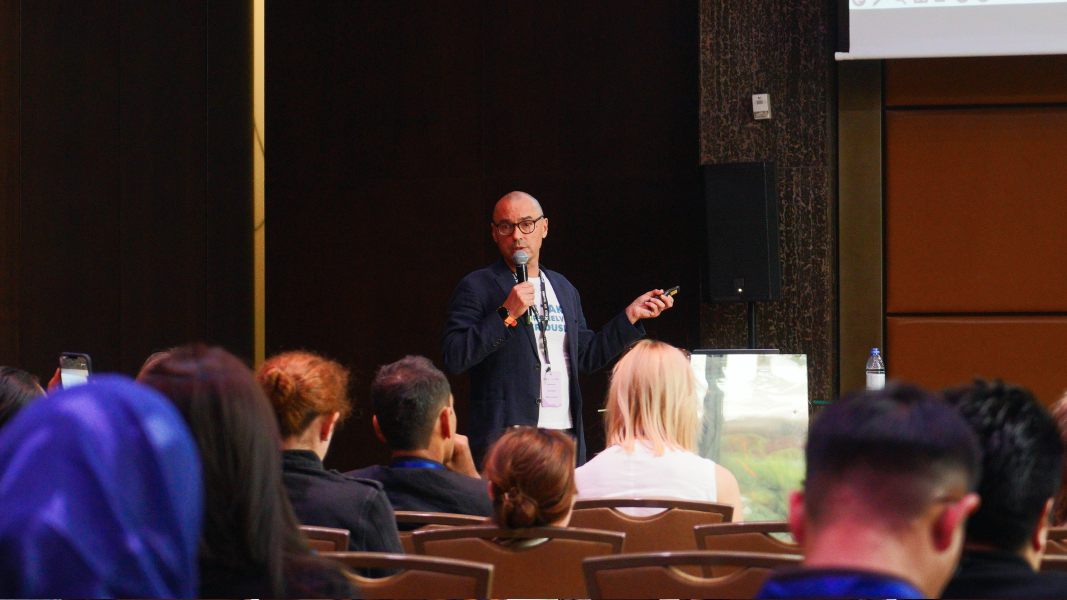
In May 2026, SAP Sapphire Madrid once again became one of the key global events for SAP customers, partners, and the enterprise technology ecosystem. Representing TeamIdea Group, Tatiana Shangina, CEO at TIGROUP, attended the conference to explore the latest SAP strategy, product announcements, and emerging enterprise AI trends shaping the next generation of digital business platforms.
This year’s Sapphire clearly demonstrated that SAP is no longer positioning AI as an additional feature inside ERP systems. Instead, SAP presented a broader strategic vision centered around the concept of the Autonomous Enterprise — an architecture where business processes, data, workflows, AI assistants, and AI agents operate together within a unified enterprise environment.
According to SAP, the future enterprise will increasingly move away from traditional transactional interfaces and fragmented applications toward intent-driven interaction models. Rather than navigating multiple systems and screens, users will formulate business intentions in natural language while AI orchestrates workflows, data, recommendations, and execution across enterprise landscapes.
“The shift presented at Sapphire 2026 is much deeper than another AI feature release,” said Tatiana Shangina. “SAP is effectively redefining how users interact with enterprise systems. The focus is moving from transactions and interfaces toward AI-driven business orchestration, contextual decision-making, and autonomous execution.”
One of the central announcements was Joule Work — SAP’s new AI-powered workspace layer designed to unify user interaction across SAP and non-SAP systems. SAP demonstrated how employees will increasingly communicate with enterprise systems using natural language, mobile interfaces, and voice interaction instead of traditional transactional navigation. SAP also announced expanded voice capabilities through its partnership with LiveKit.
For enterprise organizations, this represents a major change in user experience expectations. Employees increasingly expect enterprise software to function with the simplicity and accessibility of consumer AI interfaces. As a result, usability, conversational interaction, and workflow simplification are becoming strategic business requirements rather than purely UX considerations.
A key theme of Sapphire 2026 was the expansion of SAP Autonomous Suite, which introduces more than 50 Joule Assistants and over 200 specialized AI agents across Finance, Supply Chain, Procurement, HCM, and Customer Experience domains. SAP positions these assistants and agents as operational components capable of analyzing data, orchestrating workflows, handling exceptions, generating recommendations, and automating complex business scenarios.
For SAP consulting and implementation partners, this marks an important shift in required competencies. Expertise will increasingly depend not only on deep knowledge of SAP modules, but also on the ability to identify which parts of a business process can be delegated to AI agents, where human governance is required, and how enterprise data should be structured for safe and scalable automation.
One of the most strategically significant announcements at Sapphire was Joule Studio 2.0 — SAP’s new environment for enterprise-scale agentic development. SAP positions Joule Studio as a fully managed platform for building AI agents, workflows, applications, and orchestration layers directly inside the SAP Business AI Platform.
A particularly important concept introduced by SAP is intent-based development. Instead of relying exclusively on traditional specification-driven development cycles, consultants and business users will increasingly be able to describe business requirements in natural language while Joule Studio assists in generating specifications, workflows, code structures, and testing artifacts. SAP also highlighted deep integration with SAP Knowledge Graph, SAP Business Data Cloud, SAP Domain Models, and support for both low-code and pro-code development approaches.
From a delivery perspective, this significantly changes how enterprise solutions may be designed and implemented in the coming years. AI-assisted development models can potentially accelerate requirement gathering, workflow design, prototyping, testing, and deployment cycles while reducing implementation complexity.
Of particular interest to enterprise architects was SAP’s strategic partnership with n8n. SAP announced that n8n will become an embedded, fully managed workflow orchestration environment inside Joule Studio. This enables visual orchestration of multi-agent workflows across SAP and external systems.
For enterprise customers, this announcement is particularly important because modern IT landscapes rarely operate exclusively within SAP environments. Organizations increasingly require integrations across Microsoft ecosystems, CRM platforms, ServiceNow, collaboration tools, local enterprise applications, AI platforms, and external APIs. As a result, competencies around SAP BTP, Integration Suite, APIs, workflow orchestration, and hybrid integration architectures are becoming strategically critical.
SAP also emphasized support for open interoperability standards including MCP and A2A protocols, allowing SAP agents and third-party agents to interact across enterprise environments. This reinforces SAP’s vision of hybrid enterprise architectures where SAP acts as the governed business context layer while interoperating with external AI ecosystems and platforms.
A significant discussion point at Sapphire Madrid was the development of Company Memory within SAP Signavio. SAP positions Company Memory as a structured enterprise knowledge layer where AI agents can operate not only on documents and transactional data, but also on accumulated organizational knowledge, business rules, operational exceptions, governance models, and process context.
This approach significantly expands the role of enterprise consulting. Future SAP projects will increasingly require consultants to formalize business context, process logic, exception handling, and governance rules that can be interpreted safely by AI systems.
In the Finance domain, SAP demonstrated several practical AI-driven scenarios already moving toward production deployment, including Financial Closing Assistant, Accounts Receivable Assistant, Treasury Assistant, Billing Assistant, and Tax & Compliance Assistant solutions. These scenarios focus on accelerating financial closing cycles, improving treasury visibility, automating receivables management, reducing manual operations, and increasing financial process transparency.
For enterprise customers, these capabilities translate into practical business opportunities: faster financial close, improved cash collection, greater visibility into treasury operations, AP/AR automation, reduced operational overhead, and higher transparency across finance functions.
Sapphire 2026 also highlighted the growing importance of sovereign AI and European AI ecosystems. SAP increasingly emphasizes data residency, governance, security, GDPR compliance, and regional AI infrastructure. Partnerships involving Mistral AI and SAP Sovereign Cloud reflect growing enterprise demand for controlled and compliant AI architectures within European regulatory environments.
For TeamIdea Group, the main conclusion from SAP Sapphire Madrid 2026 is clear: enterprise AI is rapidly evolving from experimentation toward operational enterprise infrastructure.
The role of the SAP consultant is also transforming. Future SAP experts will need to combine process expertise, integration knowledge, AI orchestration capabilities, governance understanding, and enterprise architecture thinking. Successful enterprise transformation projects will increasingly depend on the ability to connect business processes, data quality, integrations, AI agents, and governance models into a unified operational environment.
“Sapphire 2026 showed that SAP is building not simply AI functionality, but an entirely new enterprise operating model,” said Tatiana Shangina. “For consulting companies and enterprise customers, this creates both a challenge and a major opportunity. Organizations that successfully combine SAP expertise with AI, integrations, BTP, and agentic architectures will define the next generation of enterprise transformation.”